
Betting Strategies in INR
These are practical betting strategies for Monopoly Big Baller that an Indian player can copy and run with INR stakes. The goal is not prediction. The game uses random balls and random multipliers, so there is no statistically correct timing. The value of these strategies is structure. They help control volatility by choosing how much of the round is spent on frequent smaller hits versus rarer higher potential outcomes.
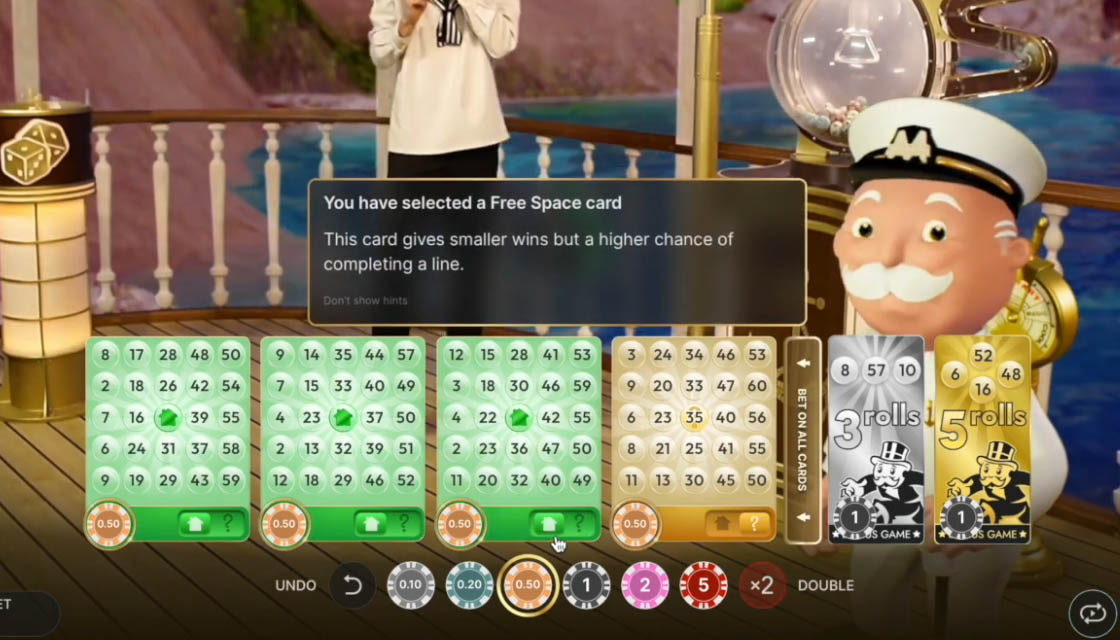
In this guide, one event means one separate wager inside a round. That can be 1 to 4 main cards, each set to Free Space or Chance, plus optional side bets on 3 Rolls and 5 Rolls for the 3D Monopoly bonus.
How the Round Works in Plain Terms?
The round has a fixed rhythm, so the strategies below stay easy to follow even when the table feels fast.
- The player can bet on 1 to 4 cards, and each card is set to either Free Space or Chance before the round locks;
- After betting closes, Mr. Monopoly adds random daubs and random multipliers such as Standard, Line, and Global;
- Then 20 balls are drawn from 60, and completed lines pay, with more lines increasing the total payout;
- Separately, the player can add 3 Rolls and 5 Rolls side bets to try to enter the 3D bonus.
The strategies below assume that the player stays consistent for a defined number of rounds. That is the simplest way to avoid impulsive bet changes.
Pick a Unit Size in INR
To keep decisions consistent, it helps to set a unit size "U" and build every round from that. "U" should be small enough that a 20 to 30 round run still feels comfortable. The quick unit guide below shows common INR choices and what a typical round total looks like.
| Unit U | 1 card | 2 cards | 3 cards | 4 cards | 4 cards plus 3 Rolls tail |
|---|---|---|---|---|---|
| INR 25 | INR 25 | INR 50 | INR 75 | INR 100 | INR 112.5 |
| INR 50 | INR 50 | INR 100 | INR 150 | INR 200 | INR 225 |
| INR 100 | INR 100 | INR 200 | INR 300 | INR 400 | INR 450 |
For the examples below, "U" is shown as INR 50 for easy math. Any other unit works by multiplying every number by the same factor.
One Event Per Round
Bet: 1 Free Space card at 1U. How to run it: Keep the same setup for 20 to 30 rounds without switching card type. Why it works as a baseline: Free Space tends to feel steadier because it aims for more frequent line action, while still leaving room for random multipliers. INR example: U equals INR 50, so the round bet is INR 50. Bet: 1 Chance card at 1U. How to run it: Commit for 15 to 25 rounds with no switching. Why it is higher variance: Chance can run colder, but the player is explicitly accepting fewer hits in exchange for a higher upside profile when multipliers land on paid lines. INR example: U equals INR 50, so the round bet is INR 50. Bet: 1 card at 1U, switching the type on a timer. How to run it: 5 rounds Free Space, then 5 rounds Chance, then repeat. Why it helps discipline: It alternates frequency and upside without adding complexity or chasing recent results. INR example: U equals INR 50, so the round bet is INR 50, with a type change every 5 rounds.One Card for Stability
One Card for Multiplier Hunting
Timed Switcher
Two Events Per Round
Bet: 1 Free Space card at 1U plus 1 Chance card at 1U. How to run it: Keep the split fixed for the full session. Why it is useful: One card is positioned for steadier line frequency, while the other stays open to higher upside from multipliers. INR example: U equals INR 50, so the round bet is INR 100 total. Bet: Free Space 2U plus Chance 1U, total 3U. How to run it: Hold about 70 percent of the round budget on Free Space and 30 percent on Chance. Why it fits longer sessions: It often reduces deep swings while still keeping a real chance for a strong multiplier outcome. INR example: U equals INR 50, so the round bet is INR 150 total. Bet: Free Space 1U plus Chance 2U, total 3U. How to run it: Keep the same split for at least 20 rounds before evaluating. Why it is aggressive: This creates more empty stretches, but increases the share of the budget aimed at higher upside outcomes. INR example: U equals INR 50, so the round bet is INR 150 total.50 50 Hedge
70 30 Toward Frequency
70 30 Toward Risk
Three Events Per Round
Bet: 2 Free Space cards at 1U each plus 1 Chance card at 1U, total 3U. How to run it: Run for 20 rounds. If the player wants more risk after that block, switch to 1 Free Space plus 2 Chance for the next block. Why it feels balanced: It increases line coverage while keeping one ticket aimed at higher potential. INR example: U equals INR 50, so the round bet is INR 150 total. Bet option A: 3 Free Space cards at 1U each. Bet option B: 3 Chance cards at 1U each. How to run it: Choose one style and do not mix for 30 rounds. Why it works: It creates a consistent profile that is easier to evaluate than constant switching. INR example: U equals INR 50, so the round bet is INR 150 total. Bet: 1 Free Space card at 1U plus 1 Chance card at 1U plus 3 Rolls at 0.5U, total 2.5U. How to run it: Keep the main cards fixed. Keep 3 Rolls small and constant as a tail. Why it is practical: The main action remains in lines, while the bonus entry stays present without consuming the whole round budget. INR example: U equals INR 50, so the round bet is INR 125 total.Two Stable, One Risk
Three Cards, One Style
Two Cards Plus a Small Bonus Tail
Maximum Coverage, Four Cards and Optional Bonus Bets
Bet: 2 Free Space cards at 1U each plus 2 Chance cards at 1U each, total 4U. How to run it: Use as a default universal setup for 20 to 30 rounds. Why it is popular: It uses the maximum main card coverage without leaning fully into one style. INR example: U equals INR 50, so the round bet is INR 200 total. Bet: 3 Free Space cards at 1U each plus 1 Chance card at 1U, total 4U. How to run it: If a strong Chance hit happens, avoid increasing. Keep the scheme unchanged. Why it reduces chasing: The Free Space majority often softens swings, while Chance stays as the upside window. INR example: U equals INR 50, so the round bet is INR 200 total. Bet: 2 Free Space at 1U each plus 2 Chance at 1U each plus 3 Rolls at 0.5U, total 4.5U. How to run it: Use when the player wants the bonus to be part of the session without letting it dominate. Why it is controlled: The bonus remains an add on, not the main expense. INR example: U equals INR 50, so the round bet is INR 225 total. Bet: 4 cards, for example 2 Free Space and 2 Chance at 1U each, plus 3 Rolls at 0.5U and 5 Rolls at 0.5U, total 5U. How to run it: Keep the two bonus bets small together, usually 10 to 25 percent of the total round spend. Why it fits bonus curious players: The player sees the bonus mechanic more often over time, but avoids funding the whole session through side bets. INR example: U equals INR 50, so the round bet is INR 250 total.Four Cards, Balanced 2 Plus 2
Four Cards, Tilted Toward Stability
Four Cards Plus 3 Rolls
Four Cards Plus 3 Rolls and 5 Rolls
Bonus Focus Strategies for the 3D Monopoly Round
Bet: 3 Rolls at 1U plus 5 Rolls at 1U plus 1 Free Space card at 1U, total 3U. How to run it: Treat Free Space as a partial refund path when lines land. The core goal stays bonus entry. Why it is honest about intent: It accepts that most of the budget is aimed at bonus access, while still keeping a basic line bet live. INR example: U equals INR 50, so the round bet is INR 150 total. Base bet: Every round, 2 cards, 1 Free Space at 1U and 1 Chance at 1U. Bonus rule: Every 3rd round add 3 Rolls at 0.5U, and every 6th round add 5 Rolls at 0.5U. Why it is sustainable: The bonus is present often enough to feel real, but the player is not paying for it every single round. INR example: U equals INR 50, so the base is INR 100 per round, with an extra INR 25 on the bonus rounds.Bonus Focus With a Safety Net
Bonus Every Third Round
Dynamic Strategies With Simple Rules
Start: 1 Free Space card at 1U. Rule: If 2 rounds in a row have no win, add 1 Chance card at 1U. After another 2 no win rounds, add 1 Free Space at 1U. After another 2 no win rounds, add 1 Chance at 1U, reaching 4 cards. Reset: After a meaningful win, defined by a clear threshold such as 3U or more, drop back to 1 or 2 cards. Why it helps: Coverage increases only during a dry stretch, and it reduces exposure again after a strong return. Base: 2 cards, Free Space 1U plus Chance 1U. Rule: If the round finishes positive, add 0.5U to both cards next round. If the next round is also positive, add another 0.5U. Reset: If any round ends negative, return immediately to the base bet. Why it helps: It builds pressure only inside a short positive run, and it prevents long uncontrolled ramps. Base: 3 cards, 2 Free Space and 1 Chance, all at 1U. Rule: After a big multiplied win, play minimal for the next 1 to 2 rounds, such as 1 Free Space at 1U, then return to base. Why it helps: It protects against the most common mistake, which is over betting right after a high emotion win. Plan: Pick one scheme, for example 4 cards in a 2 plus 2 split, and play exactly N rounds, such as 30. Limits: Set a stop loss and a stop win in units, such as minus 20U and plus 15U, then end the session when either limit is reached. Why it works: This is not a math edge. It is a discipline edge. It prevents tilt and prevents turning a short session into a long chase.Event Ladder
Press on Success, Two Steps
Anti Press After a Big Hit
Hard Limits With a Fixed Scheme
Final Reality Check for Indian Players
Monopoly Big Baller is random by design. Balls, daubs, and multipliers do not follow a predictable cycle, and trackers show history rather than a signal. The strongest practical approach is to pick a unit size in INR, choose one recipe that matches the desired risk level, and run it for a fixed block of rounds. That is how the player makes the session controllable, even when outcomes are not.
Monopoly Big Baller Strategy Basics
In Monopoly Big Baller live game, a player makes only a few real choices. Everything else is handled by the game and cannot be influenced. A solid Monopoly Big Baller strategy focuses on the choices that are under the player’s control and treats outcomes as random.
| Category | Examples |
|---|---|
| Things a player controls | Session bankroll; stake per round; Free Space vs Chance card mix; bonus bet size; stop loss and take profit rules |
| Things a player does not control | Drawn numbers; when the board feature triggers; dice rolls; the house edge over time |
Once the game is framed this way, it becomes easier to avoid chasing “patterns”. The focus shifts to simple rules for staking, limits, and exits. That is where strategy actually lives.
Risk Levels
Every player has a different comfort level with variance. Lower risk usually means smaller swings and longer sessions. Higher risk means fewer rounds and bigger moves in both directions. A strategy works best when it matches the player’s budget and tolerance for swings. The table below is a simple reference point. The INR ranges are examples, not fixed rules:
| Risk level | Example bankroll in INR | Round cost as % of bankroll | How it feels in practice |
|---|---|---|---|
| Low | 1000-3000 | About 3-4% | More rounds; smaller swings; slower drawdowns |
| Medium | 3000-7000 | About 4-6% | Clear swings; balanced pace; occasional stronger rounds |
| High | 7000+ | About 7-10% | Fewer rounds; higher variance; bigger session swings |
A player can start with the row that feels realistic, then build the stake size and card setup from there.
Bankroll and Bet Sizing Rules
For Monopoly Big Baller in India, start by setting a session bankroll you are not planning to top up. If you hit your loss limit, the session ends. Many players keep the total cost of one round somewhere around 3% to 8% of that bankroll. Closer to 3% usually means a steadier, longer session. Closer to 8% brings bigger swings and a shorter runway. Next, split that round spend between main cards and bonus bets. A common starting point is roughly five parts on main cards to one part on bonuses. If you want more variance, a three to one split is a simple adjustment. The point is to change the mix on purpose, rather than making random stake jumps mid session.
Ready to Use Monopoly Big Baller Strategy Patterns
You do not need a different plan every time. A few repeatable setups cover most sessions. Start with one, run it for a few sessions, and only tweak one variable at a time.
Low Risk Stakes
This setup suits beginners and smaller bankrolls. The aim is to stay in the game for more rounds and avoid letting a short dry spell push the stakes up. Most of the spend stays on main cards, with a small bonus bet or none at all.
For example, with a 2000 INR bankroll, three Free Space cards at 40 INR each plus one small bonus bet at 20 INR costs 140 INR per round. That is about 7% of the bankroll, which may feel swingy for a “low risk” session. If the goal is a softer pace, lowering the stake or playing fewer cards is the simpler fix.
Volatility can also be adjusted through the card mix. More Free Space usually means more frequent small hits. Adding a single Chance card can bring occasional multiplier spikes without turning the session into an all or nothing chase.
Balanced Strategy
This setup is for mid sized bankrolls and players who want a steady pace with some upside from multipliers and board moments. A common approach is to mix Free Space and Chance in similar numbers, then keep both bonus bets active at around half the main stake.
With a 5000 INR bankroll, four main cards at 80 INR each plus both bonuses at 40 INR each costs 400 INR per round. That is around 8% of the bankroll, so swings will be noticeable. This pattern works best with a planned session length, for example 30 to 60 rounds, and clear stop loss and take profit rules, rather than extending the session because it feels like something “must” be due.
High Risk
This approach suits players who are comfortable with big swings and accept that many sessions may end down. The idea is to lean more on Chance cards and keep bonus bets active, which increases variance and makes outcomes less “smooth”.
As an example, with a 10,000 INR bankroll, a player might run three Chance cards at 200 INR each and both bonuses at 150 INR each. That is 900 INR per round, or roughly 9% of the bankroll, so the session can turn quickly if Monopoly Big Baller live results run cold.
High variance play only makes sense with strict limits. For instance, set a clear take profit and a clear stop loss and stick to them. Without that structure, bigger stakes can drain a bankroll far faster than most players expect.
Monopoly Big Baller Tricks
Most Monopoly Big Baller tricks online are just superstition. The useful part is the boring part: control. Start by adjusting variance with your Free Space vs Chance mix. Keep bonus bets as a side option unless you are deliberately playing a high variance session. And avoid entry rules based on streaks, because a long gap without bonuses does not change the odds of the next round.
How to Test a New Strategy?
When testing a new Monopoly Big Baller strategy, keep it structured and comparable from session to session. If a setup only looks good because of a single standout hit, it is not reliable. The better approach is to track Monopoly Big Baller results across multiple blocks and keep a short one page summary of what you tested, what the swings looked like, and which rules you will actually follow.

Example First Session
Start with a simple test session. For example, with a 3,000 INR bankroll, set a 100 INR round cost and keep it fixed. One basic setup is three Free Space cards at 30 INR each plus a small 10 INR bonus bet. Plan a 30 round block, and set clear limits before you begin, such as stopping at 2,000 INR or 4,000 INR. After the block, note your start and end balance, the number of rounds, and whether the swings felt comfortable. Then decide whether to repeat the same setup or change one variable next time.
Common Mistakes
This quick checklist helps beginners avoid the most common traps.
- Set a fixed session bankroll in INR and define a stop loss and take profit level;
- Choose one setup and write down the stake per card and any bonus bet amount;
- If you are using a promotion, check the bonus rules and whether live games count toward wagering;
- Keep the same stake size and card mix for at least the first 20 rounds;
- Pick one clear stop signal, such as frustration, fatigue, or loss of focus.
When you keep the focus on what you can control, Monopoly Big Baller strategys becomes a practical tool. It will not remove the house edge, but it can help you manage the pace, protect your INR, and make it easier to walk away when the session goes your way.